


For years, mobile game commerce had one obvious checkout: the app store.
The store distributed the game, stored the user’s payment method, handled tax and fraud, delivered the purchase and retained a platform fee. That convenience made Apple and Google part of nearly every virtual-currency transaction.
Now publishers are building another checkout on the web.
A 2026 Appcharge industry survey reported a median D2C share of 15% among respondents. Applied to Newzoo’s estimate of $113.3 billion in 2025 mobile-game in-app purchase revenue, that implies a market of roughly $17 billion. The methodology was explained by PocketGamer.biz.
That number is directional, not audited. It still describes a structural shift: the checkout is becoming part of the game publisher’s product.
Where the $17 billion estimate comes from
| Input | Value | Caveat |
|---|---|---|
| Estimated 2025 mobile-game IAP market | $113.3B | Newzoo market estimate |
| Median D2C share in publisher survey | 15% | Survey result, not a universal market share |
| Implied D2C revenue | About $17B | Calculated estimate |
The calculation is approximately $113.3B × 15% = $17.0B.
It should not be reported as if payment processors collectively disclosed $17 billion of completed web transactions. Survey respondents may be more advanced in D2C than the average publisher, definitions of D2C can differ, and store estimates do not perfectly capture every purchase.
The value of the number is scale. Off-app purchasing is no longer an experiment at the edge of mobile gaming.

The margin is the first attraction
App stores often retain a meaningful share of a digital purchase. A web shop replaces that single platform relationship with a different cost stack:
- Payment processing.
- Merchant-of-record or tax services.
- Fraud and chargeback management.
- Customer support.
- Storefront technology.
- Marketing incentives used to move players to the web.
The web is not free. It can still leave the publisher with more net revenue per transaction.
That margin creates choices. A publisher can retain the savings, offer a better bundle, fund loyalty rewards or split the benefit with the player. The strongest web shops do not merely say “buy here because it is cheaper for us.” They create visible value for making the extra trip.
But margin alone does not move a player
The in-app checkout has a major advantage: it is already open.
A D2C purchase may require the player to:
- Notice an allowed promotion or link.
- Leave the game or open a browser.
- Authenticate the correct game account.
- Trust an unfamiliar checkout domain.
- Choose a payment method.
- Complete payment.
- Return to the game and confirm delivery.
Every step can reduce conversion. The economic comparison is therefore not “30% fee versus 3% payment processing.” It is net contribution after migration friction, incentives, fraud, support and failed payments.
The second attraction is ownership
An app-store receipt completes a transaction. A good D2C system can build a relationship.
On the web, publishers may gain more control over:
- Store layout and merchandising.
- Offer timing and personalization.
- Loyalty programs.
- Email or community re-engagement with permission.
- Payment-method localization.
- Cross-platform catalogs.
- First-party purchase analysis.
Appcharge says its 2026 industry report is based on more than $700 million in D2C transactions. Its product emphasizes live personalization, loyalty, subscriptions and game-economy integrations. Appcharge’s web-store overview illustrates how the category has moved beyond a basic payment page.
The strategic prize is not just avoiding a fee. It is learning how a payer behaves across visits and giving that player a reason to return directly.
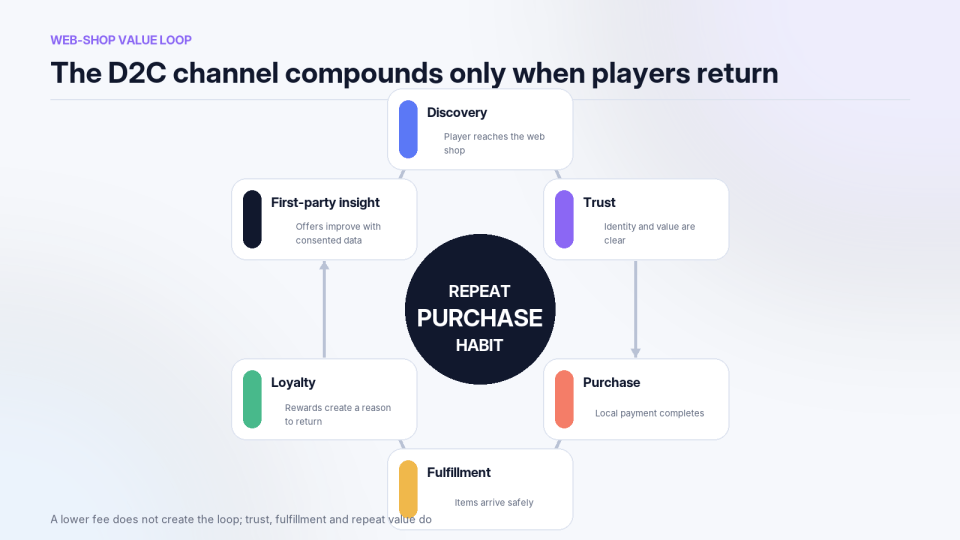
Web shops turn payments into LiveOps
The first generation of D2C stores often resembled a static catalog: currency packs on a website.
Modern systems increasingly connect commerce to the live game:
- Event-specific bundles.
- Personalized eligibility.
- Purchase limits and scarcity.
- Daily login bonuses on the web.
- Loyalty points and progress bars.
- Web-exclusive items.
- Catalog synchronization with the game backend.
Stash, for example, documents both a managed static catalog and a real-time unified catalog that can mirror a game’s existing eligibility logic. Stash’s documentation shows why integration architecture is now a product decision, not merely a payment decision.
The publisher inherits new work
Moving commerce off-app transfers responsibility.
Account integrity
The store must credit the correct game account and prevent account-linking abuse. A failed item grant is not just a support ticket; it can damage trust in the entire channel.
Fraud and chargebacks
Virtual goods are delivered quickly and can be resold or transferred. Fraud controls must understand both payment risk and the game economy.
Tax and compliance
Selling globally creates obligations around VAT, sales tax, consumer rights and payment regulation. Many publishers choose a merchant-of-record provider to assume parts of this burden.
Customer support
When the app store is no longer the seller, the player expects the publisher or its commerce partner to resolve missing purchases, refunds and payment failures.
Platform policy
Rules governing external links, steering language and alternative billing vary by platform and region and can change. Publishers need current legal and platform review; copying another game’s flow is not a compliance strategy.
The real P&L test
A D2C program should be evaluated as its own channel.
| Metric | Why it matters |
|---|---|
| Eligible payer migration rate | How much of the addressable audience reaches the web |
| Checkout conversion | Whether the external flow creates too much friction |
| Payment approval rate | Local method coverage and risk performance |
| Incentive cost | How much margin is returned to motivate migration |
| Support cost per order | Operational burden |
| Fraud and chargeback loss | Revenue that does not survive settlement |
| Repeat purchase rate | Whether D2C becomes a habit |
| Incremental net revenue | The outcome after cannibalization and all costs |
Gross web revenue is not the same as incremental revenue. Some D2C purchases would otherwise have happened in-app. The benefit is the margin difference and any additional spending or retention the channel causes.
The measurement logic resembles ad monetization. As UndrAds explains in how to prove AI AdOps lift, a new system should receive credit only for the outcome that would not have occurred without it.
D2C changes the monetization stack
A web shop does not replace ads, IAP or subscriptions. It adds another commercial surface.
That creates coordination questions:
- Should an ad-supported non-payer see a web-shop promotion?
- Should a recent web payer receive fewer interstitials?
- Which offers belong in-app, on the web or in both places?
- Does a loyalty reward improve retention or simply discount existing demand?
- How should revenue be joined with attribution and in-game behavior?
The answer is a connected stack, not a collection of dashboards. UndrAds’ guide to the modern mobile-game monetization stack maps D2C alongside mediation, analytics, attribution, subscriptions and consent.
Who is ready for a web shop?
D2C is most compelling when a game has:
- A meaningful base of repeat payers.
- Persistent player accounts.
- LiveOps and a changing offer catalog.
- A community channel that can drive store discovery.
- Server-side fulfillment.
- Enough volume to justify integration and operating work.
A new game with few payers does not become healthy by changing its checkout. Retention, value and purchase intent must exist first.
The checkout is becoming a product
The app stores won by making payment invisible. D2C cannot win by making it merely cheaper for the publisher.
It must earn the player’s additional action through better value, trust, localization, loyalty or access. The publishers that treat the web shop as an owned LiveOps surface can build a durable channel. Those that treat it as a payment link may discover that theoretical margin disappears inside migration friction.
The $17 billion estimate matters because it shows how many publishers now believe the effort is worth attempting. The next question is not whether D2C exists. It is whether each publisher can make direct purchasing feel native enough to repeat.
Frequently asked questions
Is mobile-game D2C revenue really $17 billion?
It is an estimate derived by applying a surveyed median D2C share of 15% to a $113.3 billion estimate of 2025 mobile-game IAP revenue. It is not a disclosed total of audited transactions.
Does a web shop eliminate app-store fees?
It moves the purchase outside the app-store checkout, but the publisher still pays for processing, commerce technology, fraud, tax, support and player incentives.
What is a merchant of record?
A merchant of record is the legal seller in the transaction and typically takes responsibility for payment processing, tax collection, compliance, refunds and related obligations under its agreement with the publisher.
Does every mobile game need a D2C store?
No. D2C is most useful for games with repeat payers, persistent accounts and sufficient scale. Early products should prove retention and purchase value before adding a second checkout.


