
Rewarded ads let a user choose an advertising experience in exchange for a clearly stated benefit. In a mobile game, that benefit might be a revive, a temporary boost or a limited amount of in-game currency. The placement works best when the player understands the offer and the app reliably delivers what it promised.
The useful question is how rewarded advertising affects the whole app business. Measure advertising revenue alongside retention, progression, purchases and reward reliability. A high completion rate or a strong eCPM cannot tell you whether the economy still works or whether users trust the experience.
This guide covers the mechanics, five application categories, five potential benefits, four format comparisons, five implementation areas, four advanced strategies, five metric groups and six common pitfalls. The benefits are hypotheses to test with your own audience. Public marketing claims are insufficient evidence for a guaranteed revenue or retention uplift.
How rewarded advertising works
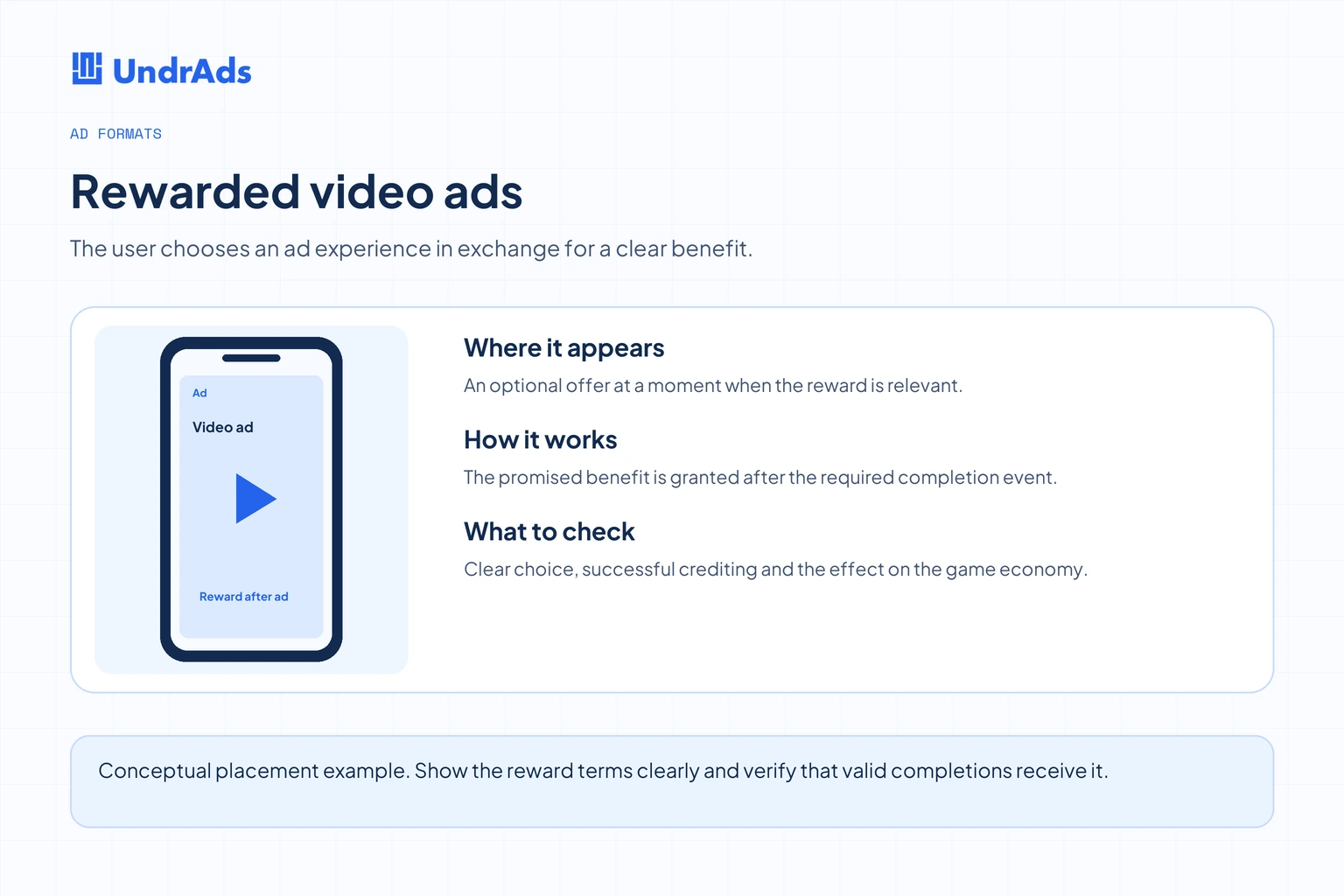
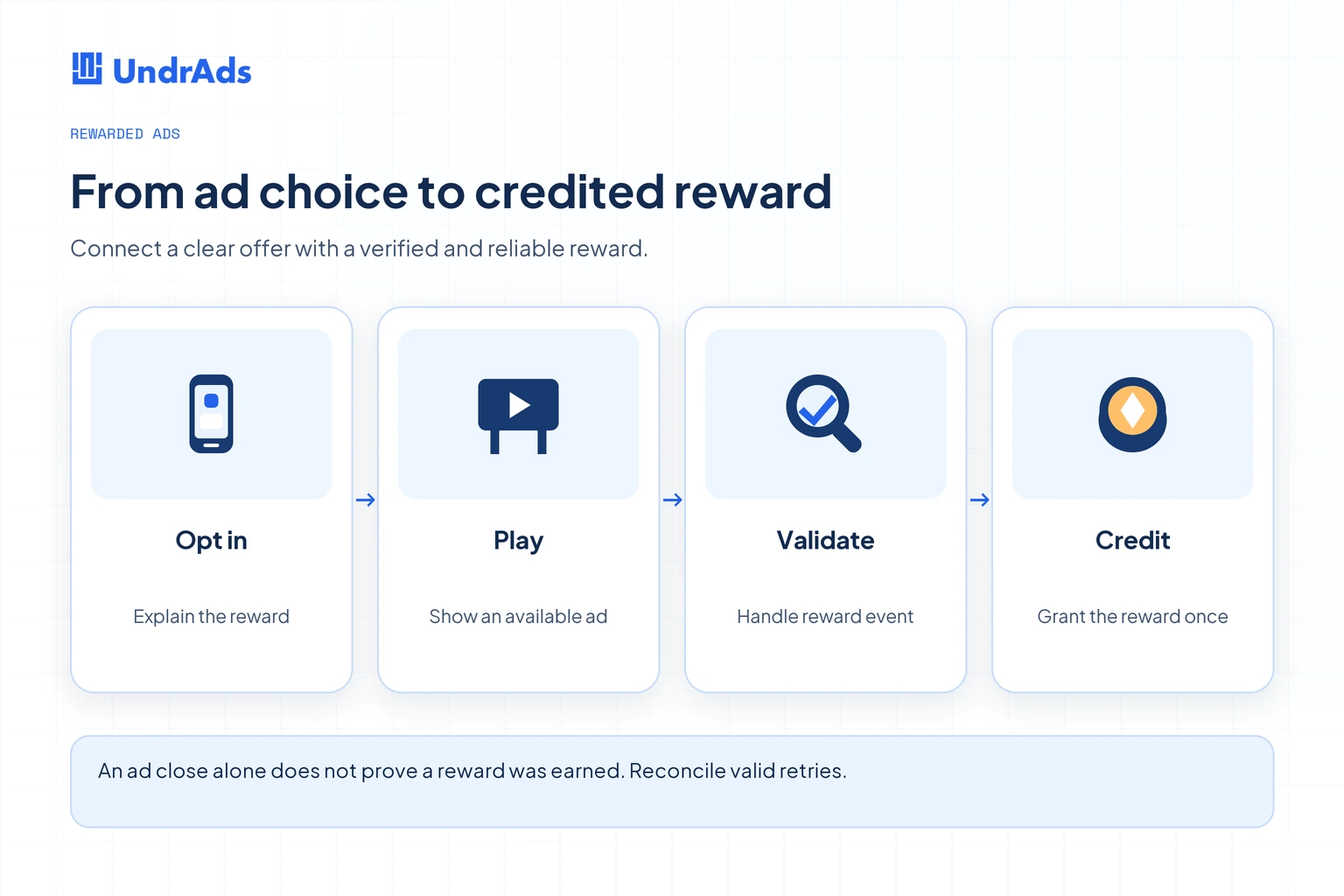
A standard rewarded placement starts with a visible offer. The user chooses it, the app displays an available ad, and the integration receives an event establishing reward eligibility. The app then grants the stated benefit and returns the user to the intended activity.
Availability, display, completion and reward crediting are separate states. An ad can be requested without loading, load without being shown, or close without establishing that a reward was earned. Instrument those states so a support complaint can be traced to the right part of the flow.
Follow the current SDK’s reward event. Google’s rewarded implementation guide distinguishes the earned-reward callback from full-screen dismissal and describes optional server-side verification. Callback ordering can differ for mediated implementations, so avoid code that assumes every partner behaves identically.
Ad duration and creative behavior can vary. Do not promise that every ad lasts a fixed number of seconds. The offer should explain the reward and the required action accurately, while the interface handles loading and unavailable inventory without trapping the user.
Respect the difference between choice and privacy consent
Choosing an optional ad is a product interaction. It does not automatically provide consent for every form of advertising data processing. Implement applicable privacy choices separately, pass the required signals through the supported SDK path and respect the user’s choices.
Google’s reward policy requires clear terms and a suitable choice mechanism. It prohibits direct monetary rewards such as cash, cryptocurrency and gift cards, and places restrictions on indirect rewards. Review the complete policy before implementing a new reward category. Other networks and stores can impose additional requirements.
Design for unavailable ads
Only offer an immediately actionable reward when the implementation can handle the current availability state. If loading is still in progress, communicate that state. If no ad is available, allow the ordinary app flow to continue. Avoid a button that promises a reward and repeatedly fails with an unexplained spinner.
A product can choose to provide a separate goodwill grant after a technical incident, but that is an economy and support decision. Keep it distinct from claiming a network reward was earned. Repeated automatic compensation for every failed load can create an exploitable currency source.
Five app categories where rewarded offers may fit
The following examples are hypothetical placement designs. They describe possibilities to evaluate, rather than claims that named apps currently use these exact implementations or that every listed reward is allowed by every provider.
1. Mobile games
A puzzle game might offer an optional extra move after a failed attempt. The value is easy to understand because it relates directly to the player’s current goal. The team still needs to determine whether the reward supports enjoyable progression or encourages levels to be tuned around repeated ad consumption.
Test the effect on level completion, later sessions and purchases. A reward that removes a frustration point can be useful, while an excessively valuable reward can make normal progression or paid items feel pointless. Include players who decline the offer in the experience review.
2. Fitness and wellness apps
A fitness app could evaluate an optional preview of an additional workout, where the content and reward arrangement comply with the provider’s rules. The offer should sit outside an active exercise sequence and preserve access to the app’s ordinary promised functionality.
Be careful about the context. An interruption during a timed activity can be more harmful than the same ad on a planning screen. Avoid making health-related claims about the benefit of watching advertising. Measure whether users return to the intended workout after the experience.
3. Media and entertainment apps
A media app might test access to a limited extra piece of eligible content. The content rights, subscription terms and advertising rules need review before implementation. Clearly state what is unlocked and for how long.
Keep the decision at a suitable content boundary. Users should not discover halfway through an activity that continuing requires an unexpected ad. Compare repeat engagement and subscription behavior, including whether ad-based access changes the perceived value of an existing paid plan.
4. Productivity and utility apps
A utility app could offer a bounded use of an optional feature, subject to the applicable policy and product terms. Explain the limit before the ad so a user does not confuse a temporary allowance with permanent ownership.
Protect the user’s task. If someone is in the middle of saving work, an ad failure should not erase the work or leave the task in an unknown state. Test the complete return journey and make it possible to understand whether the allowance has been credited.
5. Commerce and loyalty experiences
Commerce rewards require particular care because monetary value and transferable benefits can create policy problems. A cash-equivalent reward should not be assumed permissible merely because the interface calls it points. Review the actual reward, redemption rules and applicable provider restrictions before development.
If an allowed offer is tested, disclose eligibility, expiry and redemption conditions clearly. Include reward support and reconciliation costs in the business case. Avoid publishing an unsupported promise that rewarded ads automatically reduce customer acquisition costs or increase purchase conversion.
Five potential benefits to test
1. Revenue from users who do not purchase
Rewarded advertising can add an optional revenue path for a user who does not buy an item or subscription. The size of that opportunity depends on actual eligible audience, offer visibility, participation, available demand and successful delivery.
Estimate the opportunity with your own funnel. Begin with users eligible for the offer, then measure who sees it, chooses it, reaches a displayed ad and receives the reward. Multiplying total active users by a public eCPM headline skips most of those steps and can badly overstate expected revenue.
Use revenue per eligible user to compare placement variants. That captures changes in availability and participation that impression eCPM alone misses. Include the work needed to maintain the integration, handle support and reconcile rewards when evaluating the economics.
2. A clearer value exchange
A well-presented offer gives users a reason to choose the experience. Clear value and a predictable return path can make the placement easier to understand. That is a design advantage to investigate, rather than proof that every user prefers rewarded ads in every context.
Test whether the reward can be understood without reading a long explanation. Show the item or benefit, the amount and the action required. Avoid pressure language or a refusal button designed to embarrass the user. Ask participants what they expected before the ad and what they believe they received afterward.
Evaluate the decline path too. If ordinary gameplay becomes confusing or deliberately frustrating for users who decline, the apparent participation rate may reflect coercion rather than a useful offer. Keep a viable normal experience and review the provider’s requirements.
3. Support for engagement and progression
A relevant reward may help a user continue an activity they already wanted to complete. In a game, a single revive can create a different experience from a random currency offer on a menu screen. Placement context matters as much as reward amount.
Track what happens after crediting. Does the player return to the level, complete it, start another attempt or leave? A completed ad followed by an immediate exit may represent a poor return experience even when the monetization report records revenue.
Use a comparison group when assessing retention. Users who voluntarily watch ads can already differ from non-viewers in motivation and engagement. Comparing those groups directly does not establish that the ad caused better retention.
4. A way to sample selected benefits
A temporary benefit can help users understand an optional feature or item. In a game economy, it may let a player experience a boost before deciding whether a paid package is useful. That possibility must be balanced against the reward becoming a substitute for purchases.
Define which entitlements are temporary, which persist and how they appear in the account. A user should not need to infer whether an ad unlocked a permanent feature from an unexplained icon. Keep subscription promises and existing purchaser benefits consistent.
Measure payer behavior separately from aggregate ad revenue. Examine conversion, purchase frequency and total revenue for the assigned test groups over a suitable period. Avoid claiming a universal purchase uplift from rewarded advertising.
5. More flexibility in a hybrid business model
Ads and purchases can serve different user preferences within one product. Rewarded placements can be part of that arrangement when their value and timing are designed with the economy. The goal is a coherent set of choices.
Map the available routes to important resources: ordinary play, rewarded grants, purchases and any subscription benefits. Check whether one route makes another redundant or creates an excessive incentive to consume ads. Also consider players with limited connectivity or unavailable demand.
Evaluate total revenue and user outcomes together. A hybrid model is only useful if the combined experience supports the business. Adding another monetization route increases operational responsibility, including testing, analytics and support.
Rewarded ads compared with four other formats
Rewarded ads and banners
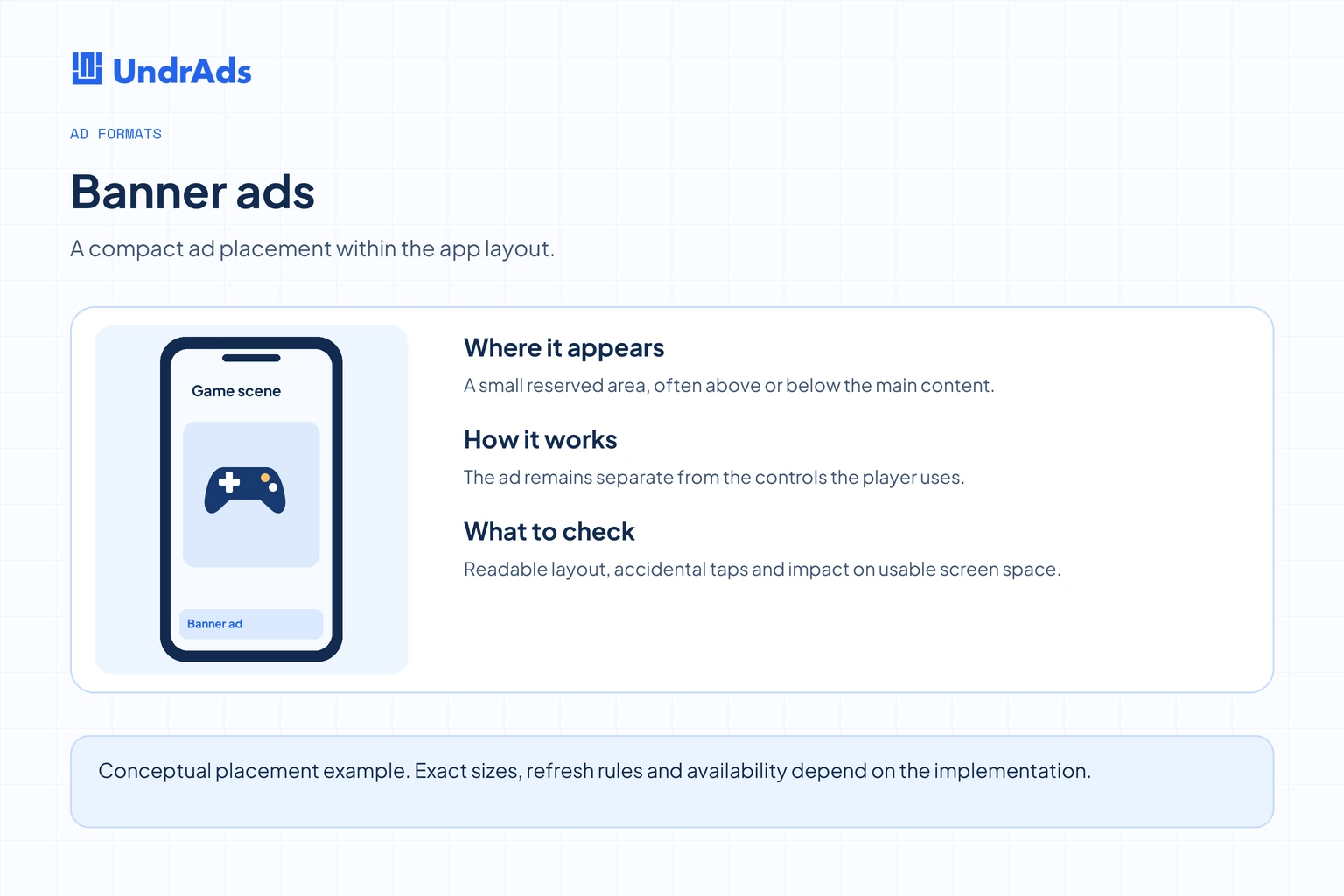
Banners occupy a reserved area within the app layout. They can coexist with ongoing content, while a rewarded placement normally asks the user to choose a separate experience. The formats solve different placement problems and should not be ranked solely by eCPM.
For banners, inspect space, accidental taps and total exposure. For rewarded ads, inspect offer participation and reward reliability. Compare revenue per user with retention and session behavior. A small banner and an optional full-screen video have different volume and attention requirements.
Rewarded ads and interstitials
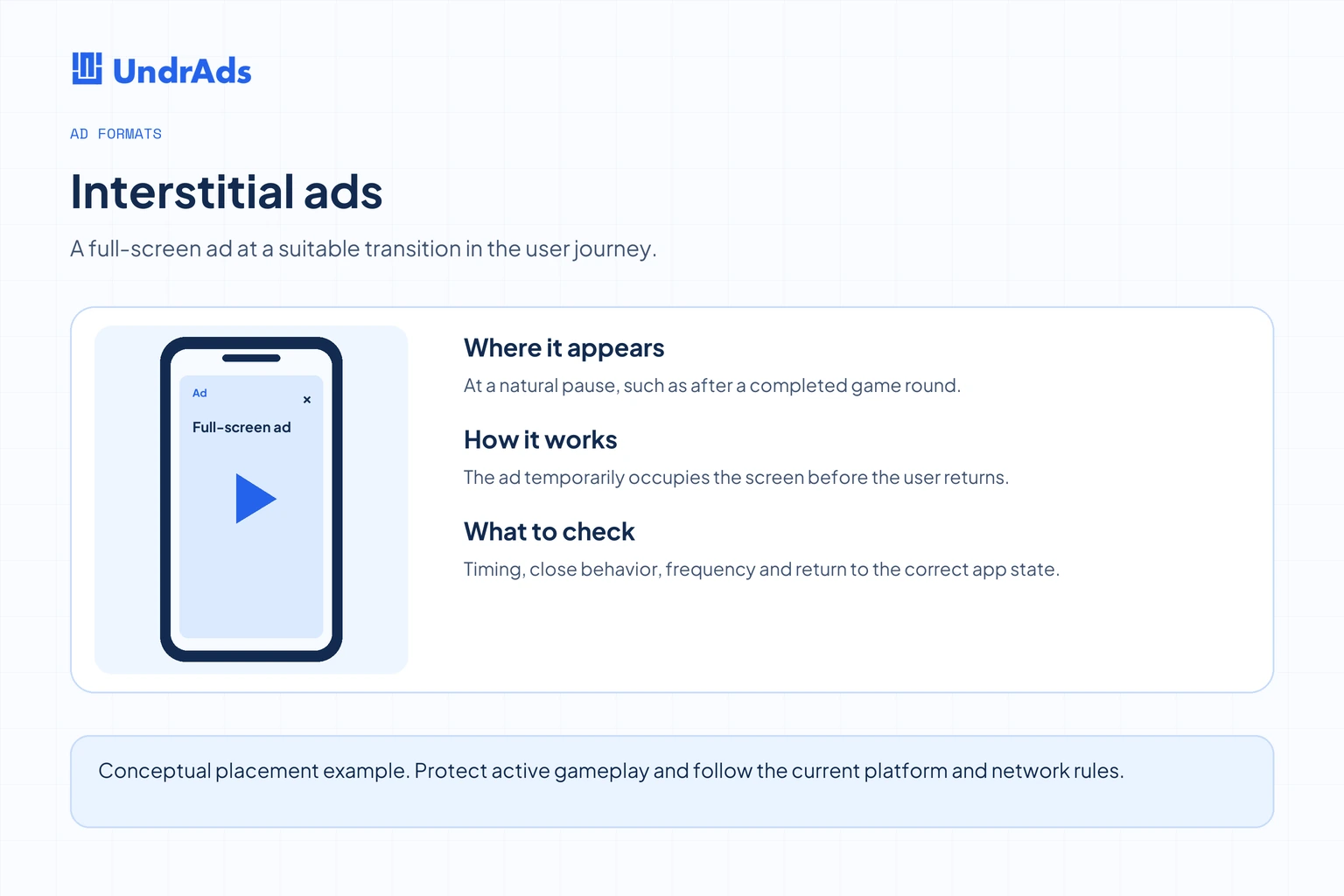
An interstitial appears at an appropriate transition without necessarily offering a reward. A standard rewarded placement starts with an explicit offer. Do not present an ordinary interstitial as rewarded merely because the app gives an unrelated item afterward.
Keep frequency rules coordinated across both formats. A player who has just chosen a rewarded ad should not immediately encounter an unexpected full-screen ad because a separate screen’s counter fired. Record the sequence in analytics so the team can identify ad clustering.
Rewarded ads and native ads
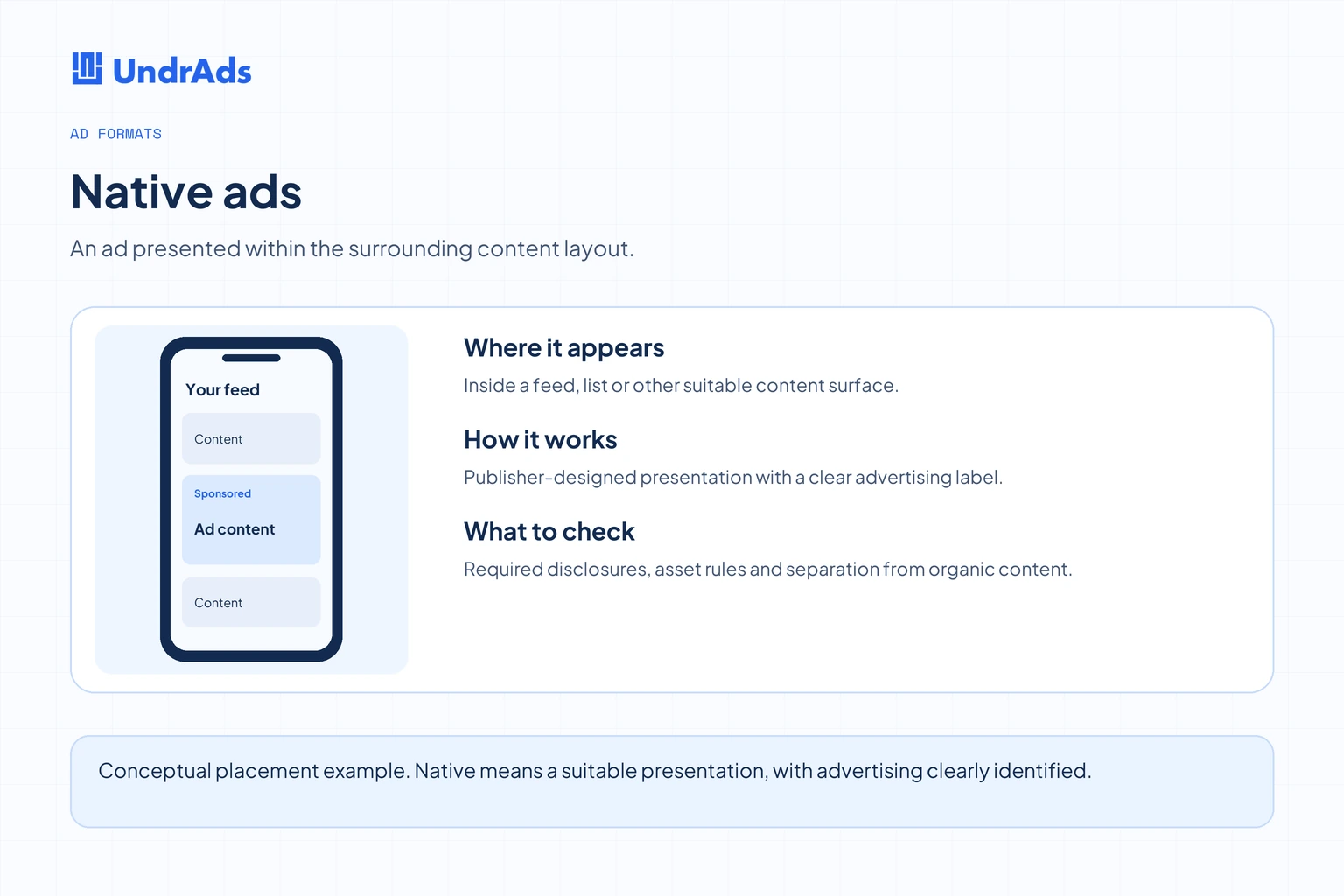
Native ads use a presentation suited to the surrounding content while retaining the required advertising identification. They need careful asset rendering and disclosure. Rewarded ads instead tie an eligible advertising action to a promised benefit.
A feed-based app may have a suitable native placement and a separate optional reward opportunity. Evaluate each within its actual journey. “Native” does not justify disguising an ad as an ordinary button, and “rewarded” does not justify an unclear or unreliable benefit.
Rewarded ads and offerwalls
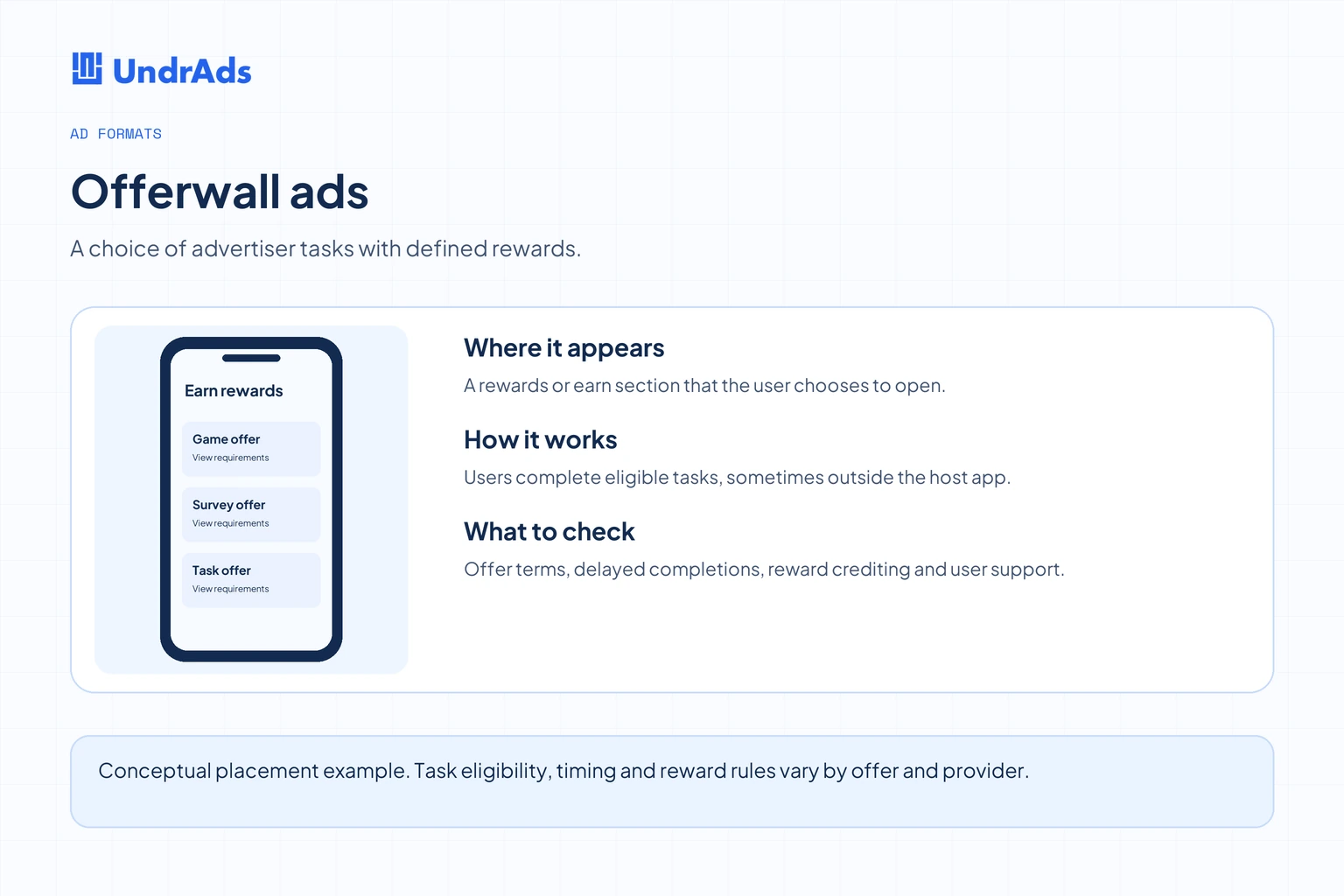
An offerwall presents eligible advertiser tasks that can have different requirements and completion timelines. A standard rewarded video usually has a more immediate in-app flow. The distinction affects support, event design and how users understand when a reward should arrive.
For offerwalls, inspect eligibility, task terms, external journeys, delayed validation and the dispute process. Do not compare revenue per task with video impression eCPM without reconciling the denominators. The apparent rate may describe a completely different unit of activity.
Five implementation areas that determine the result
1. Offer timing and placement
Choose a moment when the reward is relevant and the user can make a clear decision. A revive offer after a failed attempt has an understandable context. A pop-up during active input can interrupt the task and create accidental interaction.
Map the complete journey: eligibility, offer visibility, availability, choice, display, crediting and return. Define what happens at every failure point. If an ad loads after the offer expires or the user moves to another screen, recheck eligibility before showing it.
Preserve app state while the full-screen experience is active. On return, restore the correct screen, audio and input state. Test interruption by calls, backgrounding and network changes. The user judges the whole journey, not just whether the SDK displayed an advertisement.
2. Reward value and economy balance
Set reward value in relation to the resource’s other sources and sinks. A currency grant affects future progression and purchasing decisions even when the currency has no direct cash payout. Calling virtual rewards cost-free ignores their effect on the economy.
Document the maximum earnable amount over a normal session and day. Examine how that amount compares with ordinary play and paid packages. A limit should reflect the product design and provider rules, rather than a number copied from an unrelated game.
Run economy simulations where useful, then validate with live cohorts. Watch resource balances, progression speed and item use. A generous reward may improve immediate participation while removing the challenge or scarcity that previously supported engagement.
3. Frequency and availability rules
Define eligibility centrally so several screens do not each grant a separate allowance unintentionally. Distinguish an offer shown, an ad displayed and a reward granted when incrementing counters. Otherwise, a failed request can consume an allowance or a duplicate event can create extra inventory.
Consider the total ad experience across formats. Session length and player intent vary, so a universal fixed number of rewarded impressions is insufficient as a recommendation. Use your own participation and retention data to choose a test range.
Make unavailable inventory a normal supported state. Hide or disable an offer appropriately, provide a truthful explanation, and allow the user to proceed. Avoid endless retry loops that create repeated requests without a better user outcome.
4. Technical integration and reward reliability
Use compatible SDK and adapter versions, current integration guides and supported test modes. Confirm that every configured mediated source supports the intended format. A console entry alone does not establish that the client integration is complete.
Grant the reward from the appropriate eligibility signal. For a server-authoritative economy, evaluate server-side verification where supported. Validate the provider’s signature and required fields according to its guide rather than trusting arbitrary client data.
Use a stable transaction identifier and an idempotent crediting operation, meaning that retrying a valid transaction does not grant it twice. Persist enough state to reconcile legitimate delayed events. Keep the grant ledger separate from temporary UI state so closing a screen does not erase proof of a valid reward.
Design recovery and support together. A user should have a clear outcome when crediting is delayed. Log non-sensitive diagnostic context, define who can investigate, and distinguish an earned reward awaiting reconciliation from a failed or ineligible ad experience.
5. User interface and communication
Use direct language: identify the benefit, the action and any relevant limit. A button should describe the user’s choice rather than conceal it behind a generic “Continue.” Keep reward amounts consistent between the offer, confirmation and account balance.
Make the experience accessible. Check text scaling, contrast, screen-reader labels and small displays. Do not rely only on color or a tiny icon to explain whether a reward is available or has been credited.
Review translations and regional variants. A phrase implying a permanent unlock in one language can create a different promise from a temporary boost in another. Test the actual localized screen with representative users and confirm that the return path remains understandable.
Four advanced strategies to evaluate carefully
1. Personalization through controlled segments
Segments can help test whether a placement serves different needs for new players, returning players or different progression stages. Start with meaningful product context rather than collecting unnecessary personal information.
Keep experiment assignment stable and define the primary outcome before launch. If users move between variants based on behavior caused by the experiment itself, the comparison becomes difficult to interpret. Document exclusions and avoid hiding poor outcomes by repeatedly redefining the successful segment.
Personalization should not punish a player for declining advertising or manipulate a vulnerable audience. Review the eligibility rules with product and policy owners. Make sure customer support can explain why a particular offer appeared.
2. Hybrid ads, purchases and subscriptions
Compare the combined routes to value. If a paid package contains a resource that is also available through ads, test whether the reward changes purchase behavior. Existing purchasers may have expectations about an ad-free product or premium benefits that need to be respected.
Specify what an “ad-free” purchase means in the product and store messaging. An optional rewarded button may require a separate explanation; do not assume all users interpret the term identically. Keep the entitlement implementation consistent with the promise made at purchase.
Measure total monetization and retention across the assigned cohorts. A short ad-revenue increase can mask a later decline in purchases. Give the test enough time to observe the behavior relevant to your economy.
3. Cross-promotion and house campaigns
A studio can evaluate cross-promotion separately from paid network demand where supported and permitted. Treat it as a distinct campaign with a defined goal, such as introducing another suitable game. Avoid counting a house promotion as external advertising cash revenue.
Check attribution, reward eligibility and platform rules before using a reward in connection with another app. Do not improvise install incentives and assume all providers permit them. Keep the offer accurate about the destination and the action required.
Assess the portfolio result, including the opportunity cost of the impression. A promoted title’s installs alone do not establish that the cross-promotion is worth more than the demand it displaced.
4. Seasonal offers and live operations
A limited-time event can make a reward contextually relevant. Document start and end times, eligibility and what happens when an ad begins before the deadline but the verified reward arrives afterward. Those edge cases create avoidable support disputes.
Separate seasonal demand changes from the effect of the placement. Compare similar cohorts and note acquisition changes, events and app releases. A strong holiday eCPM should not become a guaranteed year-round forecast.
Plan the event economy before increasing reward values. Track resource issuance and sink capacity throughout the event, then review the effect on the ordinary economy afterward. Archive the rules and results so the next campaign can reuse tested components.
Five metric groups to monitor
1. Revenue and monetization
Track total ad revenue, rewarded revenue, revenue per active user and revenue per eligible user. Keep impression eCPM as a diagnostic rate with its underlying revenue and impression counts. Use consistent currency, time zone and estimated-versus-finalized status.
For an illustrative calculation, $600 from 50,000 recorded rewarded impressions equals a $12 eCPM. That example says nothing about how many active users were eligible, how many offers failed or what happened to purchases. It is arithmetic, not a market benchmark or revenue forecast.
Evaluate incremental value across the whole app. Avoid adding a network report to a mediation total that already contains the same revenue. Record fees and operating costs on the appropriate basis when calculating the business outcome.
2. Engagement and the offer funnel
Instrument eligible users, visible offers, opt-ins, load results, ad displays, earned events and credited rewards. Name the denominator in every conversion rate. An opt-in rate among users who saw an offer differs from an ad-viewer rate among all active users.
Look for the largest practical failure in the sequence. High opt-in with low display can indicate availability or loading trouble. Many earned events with few grants suggest a crediting problem. A single blended completion rate cannot distinguish those cases.
Keep repeat usage separate from first-time participation. A small group of highly engaged users can generate many impressions while most eligible users never choose the offer. Both views matter when assessing reach and economy exposure.
3. User experience and retention
Review return-to-game success, exits after an ad, session behavior, retention and support complaints. Track performance and crash signals around the full-screen journey. A placement that earns revenue but regularly loses app state needs repair.
Use experiment assignment for causal comparisons where feasible. Viewer-versus-non-viewer retention is descriptive and can be affected by self-selection. Inspect cohorts by meaningful product context without turning a small noisy segment into a sweeping conclusion.
Combine quantitative data with usability observation. Watching a few users misunderstand the reward can explain a funnel problem that the revenue dashboard cannot. Correct misleading wording before scaling a placement.
4. Purchase conversion and economy outcomes
Track purchase conversion, purchase frequency, validated revenue, resource balances and progression for the test groups. Decide whether the goal is total revenue, sustainable engagement or another specific business outcome, and report the trade-offs honestly.
Distinguish correlation from substitution. A player who watches many ads and never purchases is not evidence that ads prevented a purchase. A randomized change in reward availability or value can provide a stronger comparison when designed appropriately.
Inspect the longer-term resource impact. A temporary increase in currency balances can change behavior after the experiment window. Keep an observation period suited to the game’s economy rather than declaring success as soon as ad revenue rises.
5. Technical delivery and reward integrity
Monitor load and show failures, latency, expired ads, earned events, grant success, duplicate prevention and reconciliation time. Use platform definitions when comparing match or show rates; see the AdMob reporting glossary for its terminology.
Set alerts around failures that affect user trust, including missing valid rewards and repeated grants. Keep transaction-level access limited to the people who need it. Avoid sending unnecessary personal information in custom reward fields or support logs.
Maintain a regression test suite for the reward flow when SDKs, adapters or economy services change. Include offline recovery, app restarts and duplicate callbacks. A successful happy-path demonstration is insufficient evidence that the production ledger will remain correct.
Six pitfalls to avoid
1. Treating rewarded ads as forced progression
Do not make the normal experience deliberately unusable to push participation. An apparently high opt-in rate can hide frustration if declining the offer leaves no reasonable path forward. Review the decline journey alongside the acceptance journey.
Read the applicable reward and placement policies before adjusting eligibility. Keep the ordinary functionality consistent with the app’s promises and make sure support can explain the offer without inventing exceptions.
2. Granting rewards from the wrong event
An ad dismissal is not the same as an earned reward. UI animations and analytics events are also insufficient as the authoritative basis for a valuable entitlement. Use the integration’s supported eligibility signal and an appropriate validation design.
Prevent duplicate crediting and reconcile valid retries. A reward flow that works only while one screen remains open will fail in ordinary mobile conditions. Test interruption and recovery before broad rollout.
3. Overvaluing the reward
A large grant can increase participation while damaging progression or purchase value. Track the resource supply it creates over time. Reward size should be a deliberate economy decision with limits and measurement.
When changing value, keep other major economy variables stable where possible. Otherwise, the team may attribute a result to rewarded ads that actually came from a simultaneous change in level difficulty or store pricing.
4. Ignoring delivery and creative quality
Unavailable inventory, slow loads, confusing close behavior and inappropriate creatives can all undermine the placement. Review actual sessions and relevant complaints, not only average revenue. Maintain a process for reporting and blocking problematic advertising where supported.
Do not assume adding more demand sources resolves every issue. Each integration needs compatibility checks, testing and operational ownership. Measure whether the overall delivery experience improves.
5. Declaring success from one favorable metric
A higher eCPM with fewer impressions may produce less revenue. More rewarded revenue with lower purchases may produce a weaker combined result. Higher viewer retention can reflect self-selection rather than a causal benefit.
Define the primary outcome and guardrails before the test. Report the baseline, sample, period and uncertainty in plain language. Keep inconclusive results inconclusive rather than extending the claim beyond the evidence.
6. Neglecting policy, privacy and support
Reward design, data processing and user support are ongoing responsibilities. Review new reward categories before implementation, respect required privacy choices and keep the support process ready for delayed or disputed grants.
Document ownership across product, engineering, monetization and support. A missing reward should have a clear investigation path. Regularly revisit policies and integration requirements instead of assuming that last year’s setup remains appropriate indefinitely.
Design a rewarded-ad experiment that answers a real question
Start with a narrow hypothesis. For example, a team may want to learn whether offering a single optional revive after a specific failure improves revenue per eligible player without harming later progression. That question identifies the placement, audience, primary outcome and product guardrail before configuration changes begin.
Define eligibility before assigning the experiment. If only one variant exposes the offer, comparing its viewers with the other variant’s entire population produces a biased comparison. Where feasible, assign users consistently and analyze the eligible assigned groups, including those who decline or encounter unavailable inventory.
Record the baseline and expected practical benefit. Decide what size of improvement would justify the integration and operating work. Statistical analysis should reflect traffic, variability and the outcome being measured. Ask the analyst to set the sampling and decision approach rather than using a universal minimum duration copied from another game.
Keep other major changes controlled or documented. A new acquisition campaign, an economy rebalance and an SDK migration in the same week can all alter the result. If those changes are unavoidable, state the limitation and avoid claiming the reward placement alone caused the movement.
Monitor safety and integrity throughout the test. A missing-reward incident or a crash regression can justify stopping before the revenue comparison matures. Define those triggers in advance and preserve the evidence needed to investigate. Do not keep an obviously broken user experience live merely to finish collecting a preferred sample.
At review, report the assigned groups, dates, eligible users, revenue basis and relevant uncertainty. Include total purchases and retention even if they did not move in the desired direction. A decision can be useful when the outcome is neutral or negative, especially if it prevents an expensive portfolio rollout.
Make reward reconciliation a maintained service
A reliable reward ledger answers what was promised, what eligibility evidence arrived and whether the grant was applied. Link these records with a stable internal reference, using only the information necessary for the task. Keep sensitive account data out of public analytics properties and screenshots.
Distinguish an incoming event from a completed grant. A server may receive a valid callback while the economy service is temporarily unavailable. Store a retriable state and complete the operation safely when service returns. Reprocessing the event must preserve the original outcome rather than generating an additional reward.
Define how the client learns about reconciliation. A user returning to the app should see an accurate balance and understandable status. Avoid a permanent “processing” message with no support route. If a grant cannot be completed automatically, the team needs a documented investigation and correction process.
Set retention and access rules for diagnostic records according to the business’s requirements. Support may need to locate a disputed transaction without seeing unrelated personal details. Engineering may need an error trace without broad access to account information. Separate those needs instead of copying the entire user profile into every log.
Test the ledger with duplicates, delayed events and restarts in a controlled environment. Include a valid transaction processed twice, a request with invalid verification evidence and a grant that succeeds while its acknowledgement is lost. These cases reveal failures that ordinary happy-path testing misses.
Keep the ledger contract stable across SDK changes. A new adapter can affect client event ordering even when the underlying economy service remains unchanged. Review the integration boundary, update the test cases and confirm that the new release preserves the meaning of an earned reward.
Reuse the working components across the portfolio
Maintain shared definitions for offer shown, choice made, ad displayed, reward earned and reward credited. Give each event a documented owner and schema version. Common vocabulary makes cross-game reports useful while allowing each title to choose its own reward amounts and placement contexts.
Reuse approved interface patterns and explainers where they fit. The visual language can remain consistent even when one game offers a revive and another offers a temporary boost. Keep the precise amount, expiry and eligibility in the product’s own offer so a reused component does not create an inaccurate promise.
Archive experiment results alongside configuration and implementation notes. Record unsuccessful tests too. A later team should be able to see what was tried, for which audience and under which conditions. Reusing evidence is more valuable than repeatedly copying an unverified industry claim into a new monetization plan.
Keep reusable assets accurate
Use one approved diagram for the reward lifecycle across documentation, onboarding and support training. Keep the source file, accessible text and explanation together. When the implementation changes, update that shared reference so older instructions do not quietly contradict the current flow.
Distinguish a conceptual illustration from evidence about a live product. An example can teach opt-in and crediting without claiming that every provider uses the same screen or callback order. Product screenshots should come from the relevant official source and be replaced when they become misleading. Reusing accurate material saves work while giving players and staff a more consistent explanation.
Planning rewarded monetization
Build the plan around reliable measurement and reusable components. Standardize offer states, reward ledgers, placement naming, QA cases and analytics events across the portfolio. Shared components reduce repeated mistakes while still allowing each game’s economy to set its own rules.
Privacy changes, SDK updates and demand conditions can alter the result over time. Keep the implementation maintainable and review current primary documentation before major releases. Avoid treating an uncertain future trend as an established product capability or a guaranteed revenue opportunity.
UndrAds can help teams connect demand, configuration and monetization operations with a measured business objective. Start with the existing reward funnel and technical baseline. Agree on changes, ownership and success criteria before testing. The useful outcome is an experience that delivers valid rewards reliably and supports the app’s overall economics.