


Offerwall advertising should be judged by its actual task, reward and verified outcome. This guide keeps seven workflow stages, seven task categories, eight advertiser considerations, eight publisher considerations, eight format comparisons, eight use cases, eight potential advantages and seven limitations.
Claims about guaranteed retention, conversion, income or satisfaction have no place in a buying decision without comparable evidence. The sections below explain what to configure and measure, with provider and policy references where specific requirements matter.
What are Offerwall Ads?
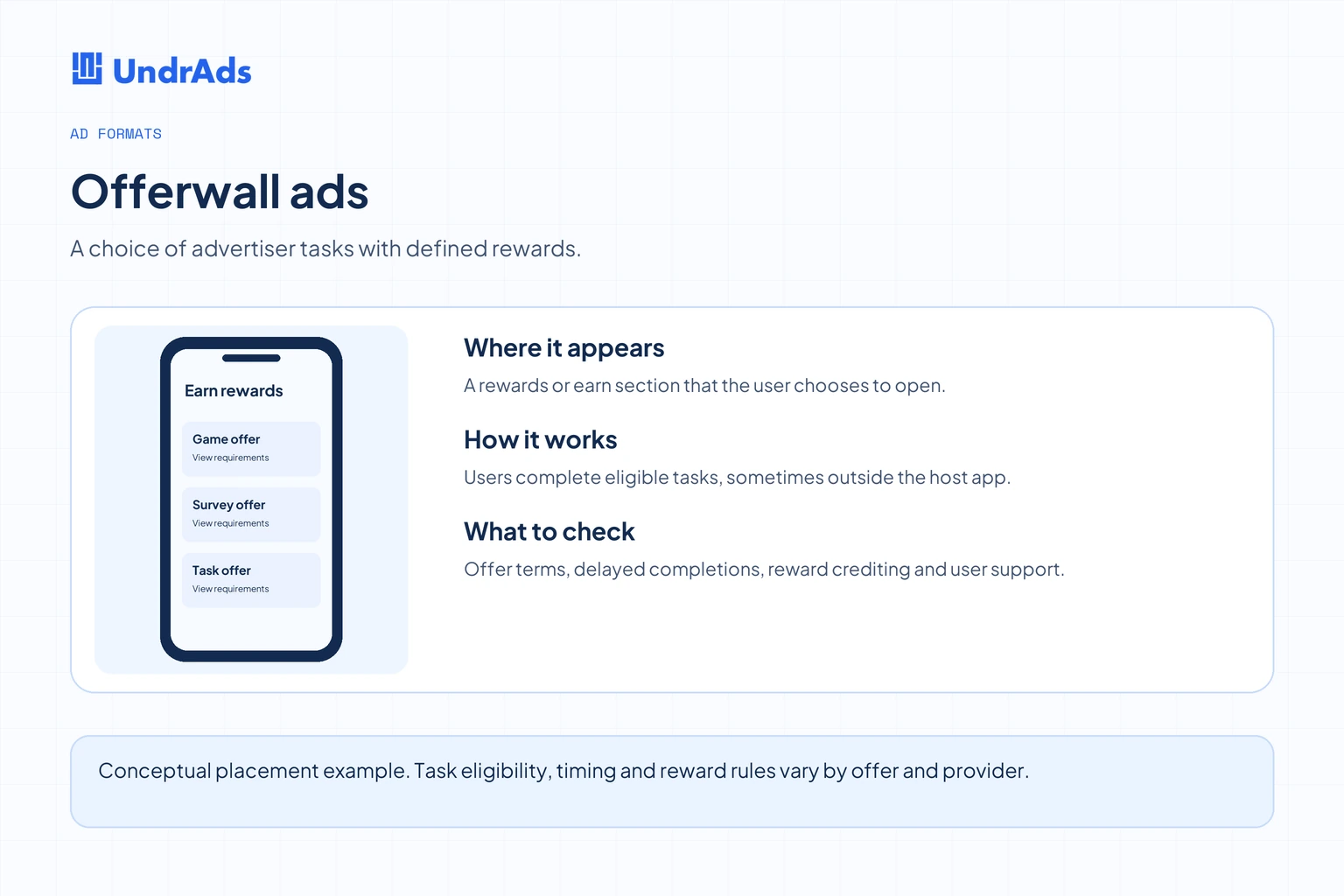
Offerwall ads present a choice of advertiser tasks in exchange for a stated benefit. A task may involve a qualifying install, progression milestone, survey or other approved action. Eligibility, completion rules and reward timing depend on the actual campaign and provider. The offer must explain the exchange before the user commits.
- The actual task and eligibility conditions
- The promised reward and permitted use
- Any deadline, cost or renewal condition
- How completion, delays and support are handled
How Offerwall Ads Work (Step-by-Step)
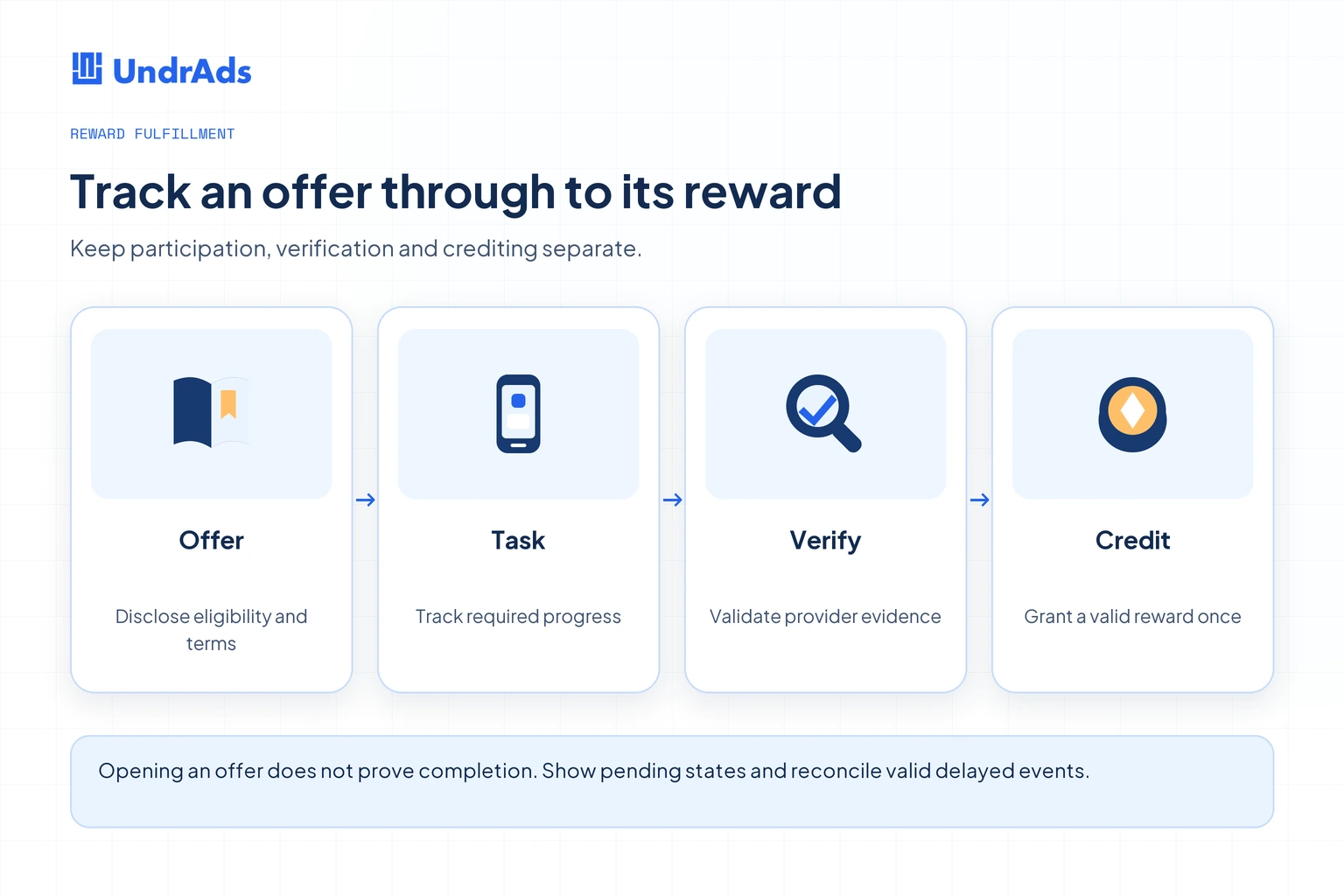
The journey has seven distinct stages. Keep their events separate in the implementation and reporting. Opening a panel, starting a task, completing a requirement and receiving a reward are different outcomes. Combining them into one “conversion” makes troubleshooting and revenue analysis unreliable.
1. User Encounters a Reward Opportunity
An entry point should be relevant and optional. Give the user enough context to understand the benefit before opening the wall. A currency shortage can be one hypothesis, but avoid presenting an external task as the only practical way to use ordinary promised functionality.
2. Accessing the Offerwall Interface
The provider presents the offers eligible for the user and environment. Coverage can vary over time, and an empty wall should be treated as a supported state. Do not promise that every user will see the same campaigns, reward amounts or task categories.
- Eligible market and distribution channel
- Supported operating system and device
- Applicable privacy choices and audience treatment
- Campaign-specific participation conditions
- The provider’s available inventory
3. Selecting an Offer
The user needs the complete requirements before starting. Keep an appropriate record of the selected offer and terms so a later dispute can be investigated. A small icon and a headline reward amount are insufficient when deadlines, costs or staged requirements materially affect the choice.
- Read the complete action requirement
- Confirm the reward amount and unit
- Check deadlines and any financial commitment
- Keep a record of the selected offer terms
4. Completing the Assigned Task
Completion may happen outside the host product and across several sessions. Preserve the user’s original state and explain how to return. Never describe a task as instant if the actual offer requires a milestone, payment, eligibility check or later verification.
5. Tracking and Verification
The provider checks the qualifying outcome through its supported measurement process. Publishers should follow the current verification guide and distinguish pending, accepted and rejected states. Verification reduces uncertainty; it does not justify claiming that all offerwall activity is fraud-free.
- Verify the provider evidence using its supported method
- Prevent repeat processing of the same eligible event
- Reconcile valid delayed transactions and failures
6. Reward Distribution
A valid reward needs a reliable fulfillment path. Use a stable transaction reference, validate the required evidence and make repeated processing safe. In a self-managed economy, the grant ledger should survive an app restart or a closed screen. A temporary interface event is a poor source of truth for an entitlement.
7. Revenue Allocation
Publisher revenue and user currency are different quantities. Their relationship follows the program, exchange rate and commercial agreement. Record estimates and later adjustments on a consistent basis. A reward granted today does not automatically imply a finalized cash payment to the publisher today.
The Value Loop Behind Offerwall Ads
The intended exchange involves the user, advertiser and publisher. All three need an outcome they can understand. A qualifying action can be recorded even when its later commercial value is weak, so accepted completion and profitable acquisition should remain separate measures.
- The user receives the promised eligible benefit
- The advertiser receives a verified campaign outcome
- The publisher records the agreed advertising value
How UndrAds Optimises This Workflow
An operating review should inspect the complete workflow rather than promise that one service removes every source of friction. Ask who controls the offer, who validates it, who grants the benefit and who handles a valid completion that has not been credited. Those responsibilities must be explicit before rollout.
- A clear provider and inventory scope
- Documented reward and economy rules
- A reliable verification and grant process
- Comparable reporting with explicit denominators
- Named support and escalation responsibilities
Types of Offerwall Ads (Seven Task Structures)
The seven categories below describe common task structures, not a universal catalog available on every platform. Provider, store, audience and market rules can exclude a proposed campaign. Review the exact offer before using its category name as evidence that it is permitted or commercially appropriate.
1. CPI (Cost Per Install) Offers
A cost-per-install offer must satisfy the actual qualifying conditions. An install alone may be insufficient where the offer also requires a first open or another event. Incentivized acquisition must be permitted by the program and applicable store rules. Keep the campaign’s new-user definition clear.
- Confirm that the campaign permits incentivized acquisition
- Check whether a first-time install is required
- Read any open or engagement requirement
- Complete the provider’s stated verification process
- An eligible app-launch campaign
- A permitted new-user acquisition test
- A publisher audience that meets the offer conditions
2. CPA (Cost Per Action) Offers
Cost-per-action campaigns pay against a defined accepted outcome. The action can have more demanding requirements than a click or install. State what qualifies, whether it requires spending and how eligibility is determined. Compare later customer value with the full acquisition and support cost.
- Registration with the required eligibility
- A defined onboarding milestone
- A permitted purchase or transaction event
- A qualifying engagement action
- Another clearly specified advertiser outcome
- What creates a billable conversion
- How the advertiser verifies the action
- Whether the user has additional obligations
- How rejected or delayed events are resolved
3. Survey-Based Offers
Survey tasks can involve qualification and screening. A person may begin a survey without qualifying for the advertised completion reward. Explain those conditions honestly and provide appropriate support. Avoid assuming that every audience will have suitable survey demand or that task duration is predictable for everyone.
- Survey eligibility is not guaranteed
- Screening can end without the full task completing
- The reward depends on the disclosed qualifying outcome
- Explain screening and eligibility honestly
- Use a suitable provider and audience
- Provide a route for disputed valid completions
- An eligible research audience
- A clearly disclosed exchange of effort and benefit
- A support process for qualification disputes
4. Progress-Based or Engagement Offers
Progress-based offers connect rewards with specified milestones. They can involve several sessions or staged grants. Each stage needs understandable requirements, a deadline where applicable and a traceable fulfillment event. Measure whether participants continue to value the promoted product after the reward condition is met.
- Reach the stated progression milestone
- Complete within the disclosed period
- Satisfy any new-user or platform condition
- Receive the reward after the required validation
- A multi-session game progression offer
- A qualifying app engagement milestone
- A campaign with documented staged requirements
5. Subscription & Trial Offers
Trial and subscription offers require particularly clear disclosure. Users must understand any payment details, renewal conditions, cancellation process and qualifying event. A reward does not remove the need to evaluate the underlying commitment. Do not turn a trial promotion into an implied free benefit when later payment is part of the terms.
- Whether payment details are required
- When a trial becomes a paid subscription
- The cancellation and eligibility conditions
- The exact event that earns the reward
6. Lead Generation Offers
Lead-generation offers request information or another qualifying expression of interest. Review who receives the information, the purpose and applicable requirements. A high submission count does not prove qualified demand. The campaign needs a meaningful acceptance rule and a downstream quality check.
- Which information is requested
- Who receives the submitted information
- What action qualifies for the reward
- How applicable consent and privacy requirements are handled
7. Hybrid & Multi-Step Offers
Multi-step offers combine requirements or reward stages. Show each stage and its value clearly. Preserve the terms applied when the user starts, particularly when a promotion ends before the final event is verified. Support should be able to identify which milestone is pending without asking the user to repeat the task blindly.
How UndrAds Uses These Offer Types Strategically
Choose task types around an eligible audience and a measurable objective. An unfamiliar label in a provider catalog is a reason to inspect the actual requirements, not a reason to assume a new revenue opportunity is suitable. Keep campaign curation, economy design and operating responsibilities connected.
- The audience is eligible for the offer
- The reward fits the host product
- The user can understand the required effort
- The integration can fulfill and reconcile valid grants
- Offer relevance by product context
- Verification and support reliability
- Combined revenue and user outcomes
- The cost of maintaining the arrangement
Why Brands Use Offerwall Ads
Advertisers may use offerwalls to acquire measurable actions under an incentive. The incentive changes user motivation, so the analysis must extend beyond the qualifying event. The following eight considerations are evaluation questions rather than guaranteed benefits shared by all campaigns.
1. A defined billable action
An action-based arrangement can make the billable event explicit. It still needs a trustworthy acceptance process, clear exclusions and a complete cost model. A verified install or registration is not automatically a profitable customer. Review what happens after the reward-related action.
2. Understand the participant’s motivation
A deliberate task choice differs from an accidental click, but it does not establish durable interest in the advertiser’s product. Some participants primarily want the benefit offered by the host. Measure subsequent behavior and keep that motivation visible when interpreting conversion quality.
- Choosing an offer deliberately
- Acting primarily to obtain the reward
- Having limited interest beyond the qualifying task
3. Measure acquisition cost and downstream quality
Lower acquisition cost and higher retention are possible test outcomes, not properties guaranteed by the format. Compare eligible cohorts using a clear period and actual downstream value. Include fraud, rejected events, support and reward-related costs where they affect the economics.
- Cost per accepted outcome
- Later engagement and retention
- Validated purchase or other downstream value
- Support, fraud and rejection costs
4. Evaluate incremental reach
New inventory or campaign types may expand reach, but availability and audience response remain limited. Repeating an offer does not eliminate creative fatigue or qualification constraints. Use controlled scaling and inspect the quality of incremental participants rather than assuming volume can grow indefinitely at the same cost.
- A controlled market-entry test
- A launch with suitable eligible inventory
- A campaign reaching a defined audience
- A seasonal offer with explicit terms
5. Use appropriate targeting signals
Use only information that is appropriate and supported for the task. More behavioral data does not automatically justify better targeting or collection. Establish the lawful and contractual handling requirements with the responsible owners and keep unnecessary personal information out of ordinary analytics and support logs.
- Permitted contextual information
- Supported market and device scope
- Campaign-specific eligibility signals
- Appropriately handled interaction data
- The minimum information needed for fulfillment
6. Build useful campaign evidence
A campaign can produce useful evidence about participation, verification and later behavior. Define the events and their denominators first. A large set of dashboards is less useful than a small set of reconciled measures that answer the acquisition objective. Keep observations, estimates and causal conclusions distinct.
- Which users are eligible
- Where participation or verification fails
- How long valid rewards take to arrive
- What behavior follows the qualifying action
- An improved offer description
- A revised onboarding step
- A better support process
- A more useful campaign measurement plan
7. Review the actual user experience
An optional experience can still frustrate users if the conditions are unclear or the promised reward is delayed without explanation. Review complaints and usability alongside conversion. A format label cannot establish that the user feels respected or that brand perception improved.
- Unclear effort or deadlines
- Unexpected payment or renewal conditions
- A valid reward that is difficult to obtain
8. Verify the provider arrangement
Assess the actual provider and operating arrangement. A vendor should be able to show the permitted inventory, reporting definitions, verification process and support responsibilities. Do not turn a marketing claim about one program into a guarantee about every advertiser, audience or integration.
- The exact inventory and provider arrangement
- The billable outcome and reporting definition
- The permitted reward and audience
- The verification and fraud process
- The support, fee and escalation terms
- A documented acquisition objective
- A consistent measurement period
- A comparable baseline or test group
- A complete cost and outcome assessment
Why Publishers Prefer Offerwalls
Publishers may consider an offerwall as another eligible monetization route. Its value depends on the host product and the work required to maintain it. The following eight areas help determine whether the complete result supports the publisher’s business.
1. An optional monetization route
A user-initiated entry can preserve choice, provided the decline path remains reasonable and the task is described honestly. Test the complete journey from offer to return. An external task that saves a small amount of ad exposure can still create substantial effort or confusion.
2. Forecast with explicit uncertainty
Action-based revenue is not automatically stable or predictable. Demand, eligibility, acceptance and task completion can vary. Build forecasts with disclosed assumptions and ranges, then compare them with observed results. Keep unsettled revenue distinct from finalized commercial records.
- A forecast with explicit assumptions
- A consistent revenue definition
- A record of rejected and delayed events
- An operating cost and support estimate
3. Match the reward to a useful moment
A resource need or requested benefit can create a relevant context. It can also make an unclear promise especially frustrating. Match the task duration with the user’s need and avoid suggesting a multi-day offer will immediately solve an urgent in-product problem.
- An optional earn area
- A relevant resource-shortage context
- A store entry with clear reward terms
- A product milestone where the benefit is understood
- An appropriate message that users can decline
4. Measure return and engagement
Participation can move activity outside the host product. Longer task engagement is not the same as a longer or better host session. Track returns, reward use and retention for suitable comparison groups. Self-selected participants may already differ from non-participants.
- Returns to the host product
- Use of the credited reward
- Progression and session behavior
- Retention for the assigned comparison groups
5. Evaluate the advertising mix
An offerwall can be evaluated alongside other advertising formats. It should not be assumed to replace them one-for-one. Compare total revenue and user experience after accounting for any displaced impressions, purchase changes or extra operating work.
- Banner placements in reserved space
- Interstitials at suitable transitions
- Standard rewarded advertising opportunities
6. Govern reward and placement controls
Provider controls may support different placements and rewards. Confirm what is actually available in the selected integration and who owns each setting. Centralize rules that must be consistent across screens so the product does not promise conflicting rewards or eligibility.
- Where the entry is visible
- Which eligible offer categories appear
- What reward and limits apply
- Who is eligible to participate
- How availability and support states are communicated
- New users after they understand the product
- Returning users with a relevant resource need
- Other appropriately defined and eligible cohorts
7. Confirm platform support
Support varies across Android, iOS, web and other environments. A provider’s availability in one channel does not establish support in another. Verify the precise SDK or web path, audience rules, store requirements and account handling before planning a cross-platform rollout.
- Supported Android implementations
- Supported iOS implementations
- Eligible web integrations
- Other explicitly supported host environments
- A reviewed cross-platform account and reward design
8. Require operational accountability
Trust comes from an accurate offer and reliable fulfillment. Ask how the service handles missing valid rewards, provider outages and configuration changes. Keep access and escalation clear. A broad assurance about automation is insufficient if support cannot investigate an individual disputed transaction.
- A verified integration plan
- Reliable and reconcilable reward fulfillment
- Useful reporting with defined scope
- Appropriate access and operating controls
- Clear human support responsibility
What makes an arrangement worth maintaining
Retention of a vendor relationship should follow demonstrated operating and business value. Review the experience for users who accept and decline offers, the validity of revenue reporting and the cost of maintenance. Keep the result tied to your actual configuration and audience.
- Accurate offers and expectations
- Valid rewards delivered reliably
- An ordinary usable decline path
- A business result supported by evidence
Offerwall Ads vs Traditional Ad Formats
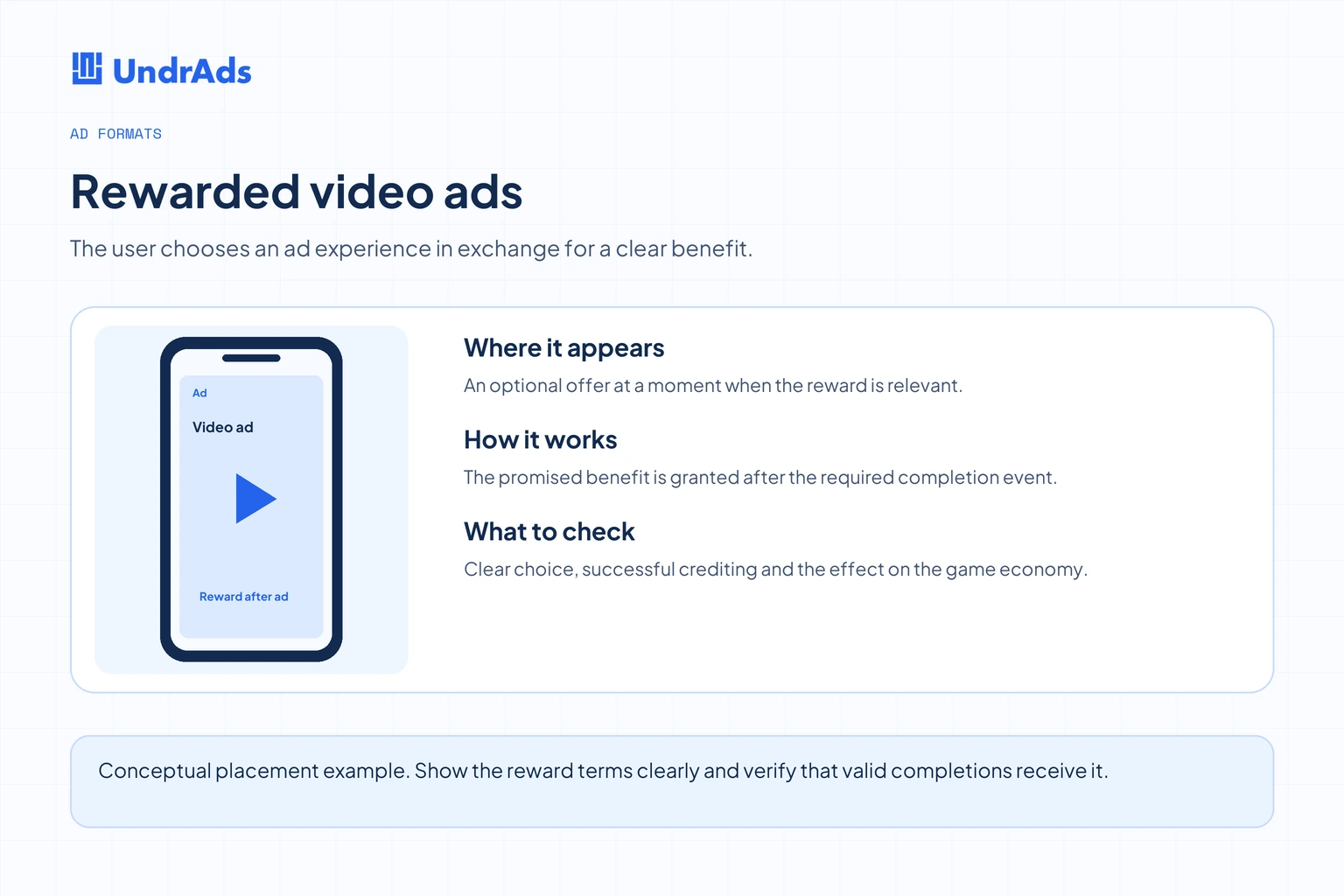
An offerwall, a banner and a standard rewarded video represent different journeys and measurement units. Eight comparisons below clarify the trade-offs. They should not be read as a universal ranking of attention, conversion or revenue.
1. Compare the choice mechanism
The product determines whether an experience is optional, appropriately placed and easy to leave. Offerwalls typically begin with a user choice, while other formats have their own placement rules. Evaluate the actual implementation rather than labeling every conventional ad as forced or every task as welcome.
2. Compare actions and motivation
Compare what the user does and why. Watching a creative, opening a task and reaching a verified milestone require different effort. Reward motivation can produce an accepted action without lasting interest. Use the measurements below to inspect the journey instead of assuming that deliberate effort proves customer quality.
- A reserved display opportunity
- A transition-based full-screen placement
- A user-initiated reward offer
- A separately governed external task journey
- Visible and understandable offer terms
- A deliberate participation choice
- A reward-related motivation
- A measurable task or milestone
- Offer starts among eligible users
- Accepted completions among valid starts
- Reward crediting after acceptance
- Later product and business behavior
3. Compare commercial units
CPM, click and action-based arrangements use different commercial units. An offerwall revenue figure per completion cannot be compared directly with impression eCPM. Name the denominator, period, revenue basis and costs before drawing a business conclusion.
- Revenue per recorded impression
- Revenue per request or page where defined
- Other supported advertising measures
- Revenue per accepted action
- Revenue per eligible or participating user
- Value after relevant adjustments and costs
4. Test the complete journey
The host experience includes loading, leaving the product, completing a task, receiving a benefit and returning. A clean entry screen cannot compensate for a broken grant process. Test all supported states and make delayed fulfillment understandable.
- The ordinary product remains usable
- The reward promise is specific
- Unavailable and pending states are clear
- Support can investigate a disputed completion
5. Define the conversion denominator
A conversion rate is meaningful only with its event and population. Comparing a task-completion rate with an advertising click rate says little about profitability. Use downstream value and a comparable cost basis when evaluating acquisition, and combined revenue per user for the host product.
- A clearly named conversion event
- A consistent eligible population
- A stated reporting period
- A comparable revenue and cost basis
6. Review user perception
User perception depends on the offer, advertising content, terms and support. Avoid promising that a reward prevents annoyance. Observe actual users and review complaints, particularly where a task involves external registration, spending or a long deadline.
7. Account for configuration work
Several task types and reward structures can be useful when supported. They also increase configuration and support responsibility. Choose the smallest set that answers the product need, then expand only after the team can measure and maintain it.
- Different eligible task categories
- Provider-supported reward configuration
- Suitable audience and placement rules
- A maintained support and measurement process
8. Connect data with decisions
Useful data connects the offer with verification, fulfillment and later behavior. More collection is not automatically better analysis. Keep identifiers appropriate, definitions stable and access limited to the people or services that need it.
- Source and event definitions
- Timely and complete reporting
- Reliable reconciliation
- Experiments tied to a business objective
A practical comparison checklist
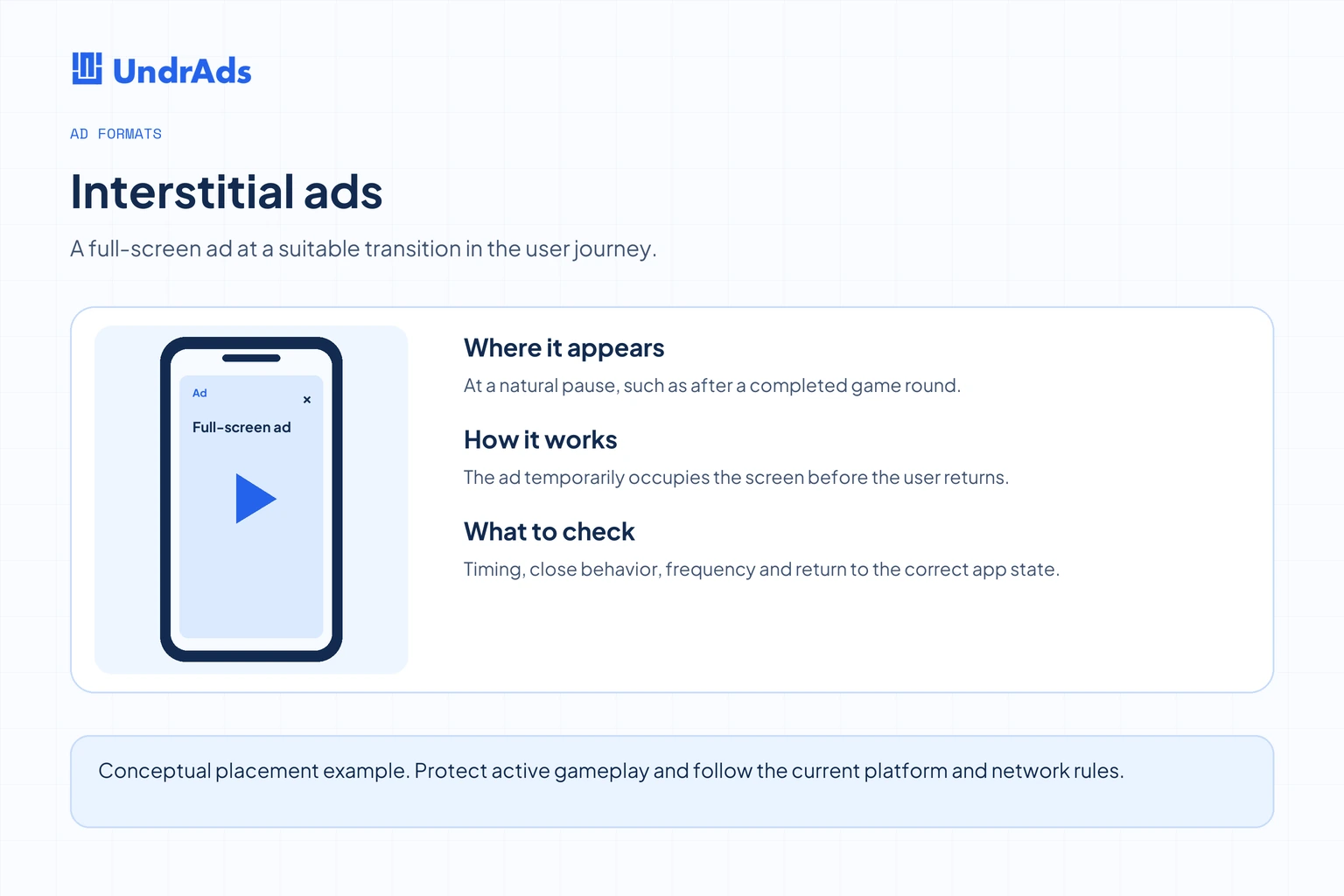
Compare the complete mechanics using the two checklists below. One records the conventional placement’s conditions; the other records the offer-based journey. Neither list guarantees revenue or user satisfaction. The objective is to identify differences the team can test.
- Placement and eligibility rules
- The denominator behind revenue rates
- User interaction and attention required
- Delivery and return-to-product behavior
- The applicable support and policy obligations
- Offer terms and task requirements
- Accepted and rejected completion states
- Reward timing and reliability
- Downstream user and revenue effects
- The total work required to operate it
Connect the comparison with monetization
A monetization review should connect those mechanics with the host product’s objective. Purchase and advertising revenue can affect one another. Include those effects rather than treating a new offerwall report as entirely additional income.
Eight possible use cases to review
The following eight contexts are hypothetical designs to assess, not claims that named products implement them. Each requires provider, audience, platform and reward eligibility review. A familiar business category is insufficient evidence that every proposed incentive is permitted.
1. Mobile Gaming Platforms
Games can offer bounded virtual benefits when the provider and store arrangement permits them. Model the reward’s other sources and uses before launch. Measure progression and purchases alongside ad revenue so a generous grant does not silently undermine the economy.
- A bounded currency grant
- An eligible cosmetic item
- A clearly defined temporary boost
- Another permitted virtual item
- A benefit with an understood economy role
- Currency issuance and spending
- Progression after the grant
- Purchase conversion and revenue
- Retention and reward-related support cases
2. Fintech & Digital Wallet Apps
Financial products and wallets need particular scrutiny. Do not launch a task or reward around financial actions without the appropriate business, provider and policy review. Avoid implying that a verified action proves the user received suitable financial guidance or that all incentives are permitted.
- The provider permits the proposed offer
- The audience and market are eligible
- The task avoids misleading financial incentives
- The required policy and business review is complete
- A truthful qualifying-action description
- Clear data and payment conditions
- A reliable reward and complaint process
- A measured downstream outcome
3. EdTech Platforms
An education product could evaluate an eligible optional content benefit, but should protect the ordinary learning experience. Review audience age, content access and task suitability. A reward should not create a misleading promise about educational outcomes or force an inappropriate external journey.
- A permitted optional content benefit
- A clear distinction from ordinary learning access
- A task suited to the actual audience
- A reviewed fulfillment and support process
4. Content & Media Websites
A content service might consider a reviewed optional access route. Check content rights, subscription promises, provider terms and the actual audience. Clearly distinguish the access benefit from any task deadline or payment condition. Evaluate whether readers return and whether paid access is affected.
- An ordinary paid access route where offered
- An explicitly eligible optional offer route where permitted
- Whether readers return to useful content
- Whether the promised access works
- Whether the offer changes subscriptions
- Whether complaints or abandonment increase
5. SaaS & Productivity Tools
A utility or SaaS product needs to protect the user’s work. If an eligible task grants a temporary allowance, state its amount and expiry. An ad or provider failure must not erase the original task or leave the user uncertain whether work was saved.
- The exact temporary feature or allowance
- The start and expiry of access
- Whether the task requires payment or external registration
- How the user returns to the original work
6. E-commerce & Retail Apps
Commerce promotions require clear redemption and eligibility terms. Avoid assuming that a discount, transferable benefit or cash-equivalent reward is allowed by every advertising program. Review the specific reward and provider arrangement before building a customer-facing promise.
- A reviewed partner promotion
- A permitted task-based benefit
- A reward with clear eligibility and redemption terms
7. Subscription Platforms
A subscription product should define how any eligible task benefit interacts with existing paid access. Do not imply a permanent entitlement when only a temporary allowance is granted. Measure subscription conversion and complaints, including the experience of existing paying customers.
8. Loyalty & Rewards Programs
Loyalty programs must evaluate the actual redemption rules and transferability of the benefit. Calling a reward points does not determine how provider policies treat it. Keep the permitted benefit, expiry and user identity handling explicit.
- A non-transferable eligible benefit
- An appropriate product privilege
- A clearly bounded content allowance
- Another reward approved for the actual program
Review operating support for the use case
An operating partner should be assessed against the actual use case, not a universal capability claim. Confirm supported integrations and the permitted reward. Agree on fulfillment, reporting and support responsibilities, then run a measured pilot against the host product’s combined objective.
- The host product’s user need
- The provider’s permitted demand
- The reward’s actual value and restrictions
- The timing and reliability of fulfillment
- Combined revenue on a consistent basis
- Retention and product usage
- Purchase and subscription effects
- Support, reliability and operating cost
Advantages and Limitations of Offerwall Ads
Keep potential benefits and limitations visible in the same decision. The format can support a useful exchange while still creating operational, economic and policy risks. Review the exact configuration rather than declaring the category universally effective or unsuitable.
Advantages of Offerwall Ads
The eight opportunities below are testable design and measurement advantages. Their value depends on implementation and audience. Use an experiment to determine whether the feature adds useful revenue without undermining the host product.
1. User-Controlled Engagement
A clear choice can help users decide whether the task is worth their effort. Review the offer description, refusal path and return journey. Participation produced by confusion or deliberately obstructed ordinary access is weak evidence of a useful experience.
- A clear offer before participation
- A viable decline path
- A predictable return to the product
2. A defined conversion to investigate
A defined task gives a concrete conversion event to inspect. High conversion alone does not establish durable engagement or profitable acquisition. Compare the accepted action with later behavior and the total cost of acquiring it.
- A defined qualifying action
- A valid comparison group
- Measured downstream behavior
3. Performance-Based Monetisation
Action-based reporting can clarify what earns revenue, provided rejection and settlement rules are understood. Record reward obligations and revenue separately. A publisher should be able to reconcile accepted events with the applicable reporting period and agreement.
- Accepted billable events
- Rejected or reversed outcomes where applicable
- Revenue and reward timing
- The cost of verification and support
4. A product experience that can be tested
A good implementation can fit the user journey. The advantage must be demonstrated through reliable grants, usable return paths and appropriate support. Do not infer lower churn or better session quality solely because the offer is optional.
- Accessible and accurate offer design
- Reliable delivery of valid benefits
- A coherent return journey
- A maintained support route
5. Flexible Revenue Strategy
Rewards and placements can support different product contexts when configured appropriately. Keep the goal and economy budget explicit. Segmentation should answer a useful question and respect applicable handling requirements rather than collect unnecessary information.
- Appropriately defined user context
- A documented reward budget
- A relevant point in the product journey
- A controlled experiment
6. A more detailed journey funnel
Additional events can reveal where the journey fails, from offer visibility to reconciliation. They are useful only when their meanings are stable. A mislabeled “completion” event can make every downstream conversion report appear stronger than the real fulfillment process.
7. Data for specific operating questions
Behavioral observations can support product decisions, but they remain subject to appropriate access and data handling. Avoid treating incentive-driven activity as a complete picture of user preference. Retain only what the measurement and support task needs.
8. Reduced Reliance on Aggressive Ad Formats
A successful offerwall can become part of a broader monetization mix. Confirm whether it adds value or mainly displaces other advertising and purchases. Keep support and technical maintenance in the operating cost assessment.
Limitations of Offerwall Ads
The seven limitations below should be reviewed before scaling. Some require a change in configuration; others can make the proposed integration unsuitable. Stopping a weak test is a useful outcome when the evidence does not support further exposure.
1. Risk of Over-Monetisation
Large or repeated grants can change the economy and user expectations. Track resource issuance, spending and progression over time. Promotions and ordinary rewarded placements may compound the supply, so review the complete set of sources and limits.
2. Potential for Low-Quality Users
Participants can focus on the incentive and leave after qualifying. Evaluate subsequent behavior using an appropriate comparison. A paid action count cannot by itself establish retention, purchase value or a lasting relationship with the advertiser.
3. Dependency on Offer Quality
Offer relevance, availability and verification depend partly on the provider and campaigns. Set expectations for empty inventory, changed eligibility and delayed results. Keep enough source context to investigate problems without making unsupported promises about every campaign.
4. User Perception Challenges
Unclear terms and missing rewards can damage trust. Review the language with representative users and check translations. Make the benefit, required action and support route understandable before the user leaves the host product.
5. Fraud & Abuse Risks
Protect verification and grant handling against invalid or repeated events. Follow the provider’s current signature and transaction requirements. Monitor anomalies without claiming that any one integration eliminates fraud. Keep access to investigation data appropriately limited.
6. Delayed Reward Dissatisfaction
Delayed verification is a normal condition to design for. Unity’s self-managed currency guide explicitly discusses delayed rewards and publisher responsibility for balance updates. Explain pending states, reconcile valid events and provide support without asking users to repeat a task that may already be complete.
7. Not Ideal for Every Platform
The host product needs a suitable audience, benefit and supported technical route. Review current App Store requirements, other applicable store policies and the provider’s terms. Do not assume an integration accepted elsewhere makes every proposed use suitable.
Build a maintained review process
Use a maintained operating checklist rather than a promise that automation resolves every risk. Assign owners for policy review, economy limits, technical fulfillment and support. Keep the configuration and evidence together so the next review can identify exactly what changed.
- Current provider and store eligibility
- Reward-value and frequency limits
- Verification and duplicate prevention
- Pending-state and support handling
- Measured revenue and product guardrails
When an offerwall is worth testing
Offerwalls are worth evaluating when the exchange is eligible, understandable and useful to the host product. Start with a limited, measurable implementation. Keep the full revenue, product and operating result visible, and preserve neutral or unfavorable findings as carefully as successful tests.
- Users receive an understandable eligible exchange
- Advertisers can evaluate accepted actions and downstream value
- Publishers can assess a maintainable combined business result
A practical pilot record
Document the eligible audience, placement, reward terms, provider configuration and event definitions before launch. Keep a comparison group where feasible and decide the primary business outcome in advance. Record acquisitions, product releases and promotions that may affect the result.
Inspect the entire funnel and the individual grant ledger before expanding. Revenue attributed to the offerwall can replace purchases or other advertising activity. Include combined revenue per user, retention, support cases and operating cost. Report uncertainty and material delays clearly.
For provider selection, use the offerwall network comparison. UndrAds can be evaluated against the specific operating requirements of a compatible setup. Confirm the actual integration and responsibilities before promising a universal outcome.